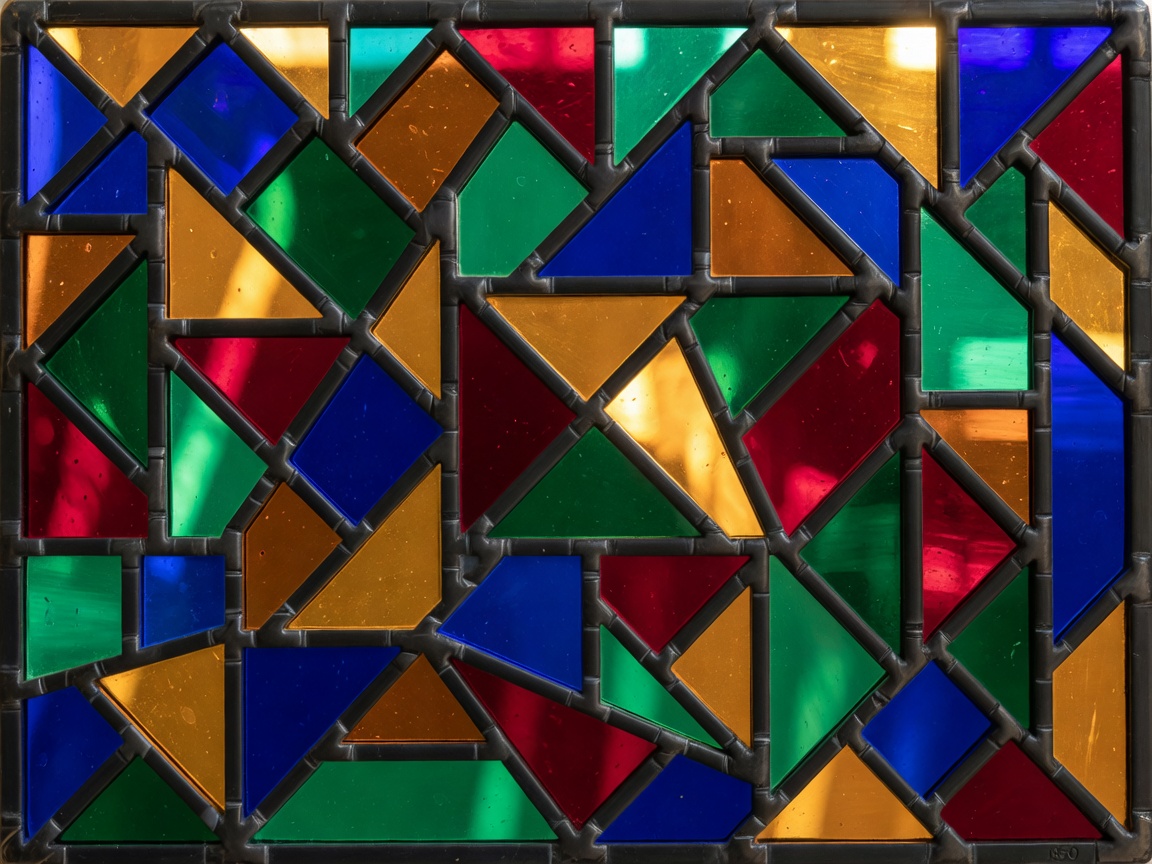
Historic glass traditions are not a single lineage. They include architectural glazing, vessels, mosaic work, colored glass, engraving, casting and many forms of surface decoration. Their histories overlap. A technique can be adapted to a new object, a material can travel, and a later workshop can revive an earlier appearance. Good interpretation distinguishes what the physical object demonstrates from what scholars infer about its making.
Stained glass and architectural glazing
Stained glass describes colored glass used in windows and related compositions. In assembled panels, individual pieces are arranged to create a larger image or pattern and joined with a supporting network. Color may be present in the glass itself or introduced through surface treatment. Architectural glazing depends on the building: light, weather exposure, structural support and maintenance all influence how a panel performs.
Surviving windows can contain repairs, replacements and changes made over long periods. A panel should not automatically be read as untouched evidence from one moment. Examination may reveal distinct materials or interventions, but interpretation requires specialist context. Modern reconstruction can demonstrate plausible methods without proving that a historic object was made exactly that way.
Colored glass and mosaic traditions
Color in glass can arise from composition and from applied or layered treatments. The visible result depends on thickness, light, surface and the glass body. Mosaic glass assembles small pieces into a larger decorative field or object. Its visual character depends on the relationship between individual units, joints and the supporting surface. Both approaches link material decisions to where and how the work will be seen.
Historical color descriptions can be imprecise. A modern viewer sees an object under different lighting and may encounter aging, deposits, repairs or conservation treatment. Avoid assuming that current appearance exactly matches its original presentation. Technical analysis and documented conservation work can refine an interpretation, but uncertainty should be stated rather than hidden.
Vessels, casting and formed objects
Decorative and functional vessels show how glass could be shaped for handling, display, storage or ritual use. Blown, cast and mould-related methods create different relationships between wall thickness, profile and surface. A vessel's form can suggest use, but function should not be assigned from shape alone. Wear, context and comparison with related finds contribute to a stronger reading.
Casting traditions can produce solid or complex forms through moulds. Mould traces, surface characteristics and repeated features may inform production research. Yet a similar form may result from related methods or later copying. Casting is also not a single historical technology: materials, moulds and production organisation vary across contexts.
Engraving and surface decoration
Engraved glass carries marks cut or abraded into its surface. Other decorative approaches can include applied elements, painting, layering, patterning or textured surfaces. Decoration may be integral to the object’s function, status or visual communication. Tools and methods left traces, but tool marks do not necessarily identify an individual maker or workshop.
Surface treatment alters how light moves across glass. A polished area can transmit or reflect differently from an abraded one. These effects can be intentional, while later wear can also change appearance. Comparative study should consider the object’s present condition and conservation history.
Workshop practice and changing methods
Workshop practice developed through material knowledge, available tools, labour organisation, customer demand and exchange between makers. Techniques could be retained, adapted or lost. Written records describe only some aspects of work; surviving objects provide physical evidence but rarely a complete account of daily practice. Historical reconstruction can test ideas and support teaching, but it is interpretation, not direct proof of every past action.
Technological change did not erase earlier approaches in a simple sequence. Older processes might continue alongside newer ones, or return in adapted form. A historical overview should therefore avoid treating one technique as universally primitive and another as automatically advanced. Each method answers different material and cultural needs.
Advantages and limitations of object-based reading
Objects give researchers direct access to material, form and visible traces. Comparing multiple examples can expose patterns that written accounts omit. The limitations are equally important: objects may be incomplete, altered, displaced or difficult to date precisely. A single feature rarely settles questions of origin or authorship. Combine material evidence with documented context and clearly label uncertainty.
Good for
This guide supports museum visits, introductory research, architectural interpretation and comparison between historic and contemporary methods. It is useful when asking how glass carried color, how decoration met function, or how a building shaped the requirements of glazing.
What to know
Separate the object's physical evidence from an interpretive reconstruction. Check whether an attribution is certain, proposed or debated. Consider repairs, conservation, lighting and reuse before treating a surface as original. For connected context, see European Glassmaking Regions and Glassmaking Techniques.